Wednesday, May 1, 2013


Visit to the War Remnants Musuem.

The War Remnants Museum is a war museum at 28 Vo Van Tan, in District 3, HCMC (Saigon). It primarily contains exhibits relating to the American phase of the Vietnam War.

The museum comprises a series of themed rooms in several buildings, with period military equipment placed within a walled yard.  There is one building that reproduces the "tiger cages" in which the South Vietnamese government allegedly kept political prisoners. Other exhibits include graphic photography, accompanied by a short text in English, Vietnamese and Japanese, covering the effects of  Agent Orange and other chemical defoliant sprays, the use of napalm and phosphorus bombs, and "American war atrocities". 


I felt the the exhibits had a strong anti-American propaganda in them and should be taken with a pinch of salt. The photographs shown depicted the Americans are cruel and ruthless people who enjoyed the cruelty of the Vietnam war.


my cute boy.


we then visited the post office :)


cute little figurines taken at the post office

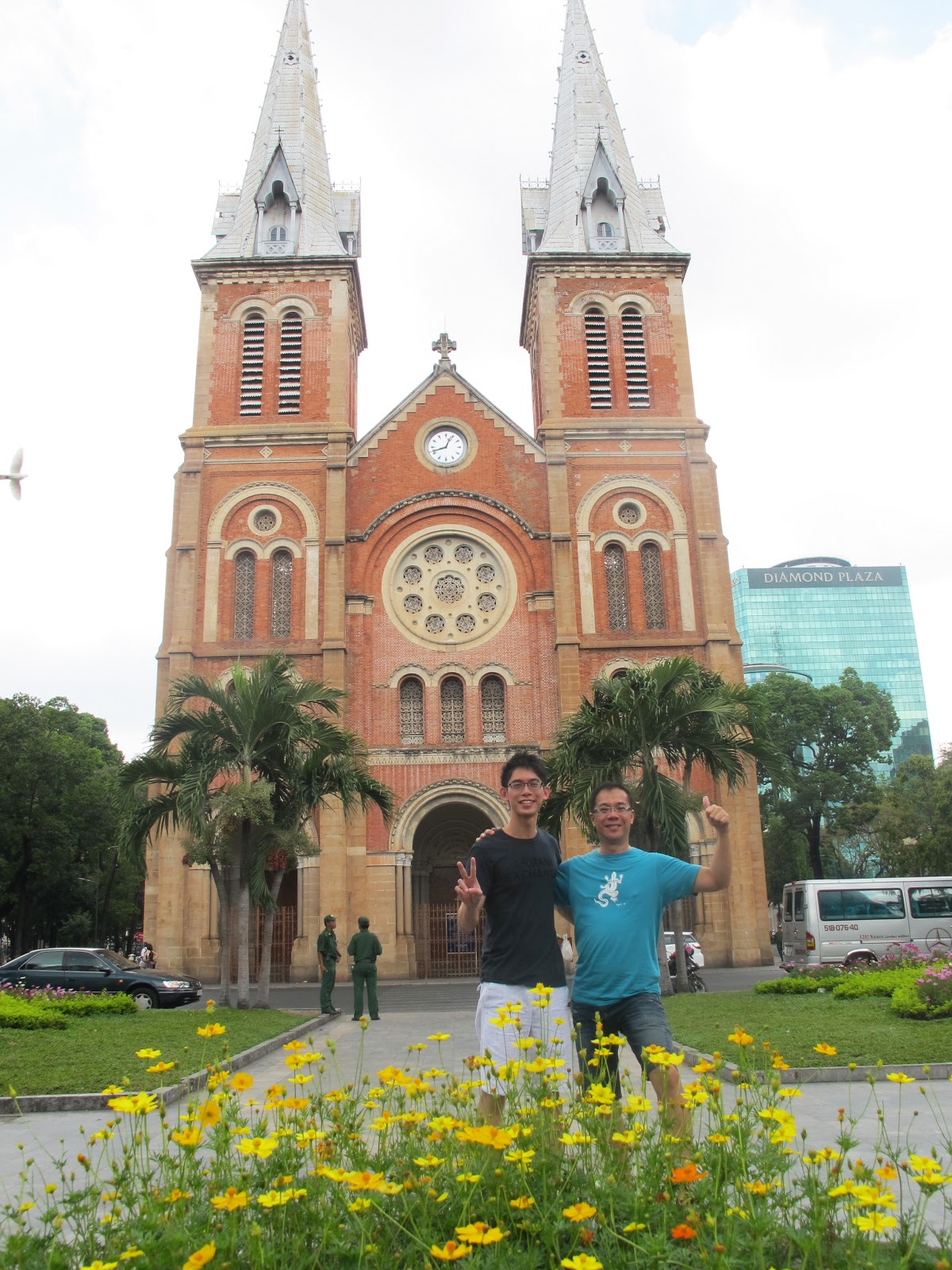
Taking pictures outside the Saigon Notre-Dame Basilica ^.^


I was actually rather petrified of being lifted about 50cm above the ground :/


sigh of relief. haha.


And here's a HUGE THANK YOU to our wonderful host, Uncle Lawrence! He was such a good host, offering us a cosy room and a wonderful chauffeur, bringing us around to absorb the sights and sounds of HCMC and splurging on our (very delicious) meals every night!
Truly, our trip would not have been such an enjoyable one without his hospitality :)


we loved, LOVED this quaint little restaurant called Cuc Gach Quan . Located in a colonial villa tucked into a quiet residential street, Cuc Gach Quan is modeled after the living and dining rooms of a typical house. The restaurant is cluttered with vintage items that are recycled. The two-story house is filled with old wooden furniture, and even the outdoor tables are refurbished instead of new. The earthenware serving bowls look worn with use and are slightly chipped, while utensils are placed in a metallic bucket. It felt really homely and nostalgic, like having a meal in a 80's colonial home. 

Apart from the cosy feel of the restaurant, what i loved about the restaurant was the little surprises that could be found in their food! They used pandan looking like leaves as bottle caps and the stem from the water morning glory as straws for their fruit juices ^.^


Soft fluffy squares of bean curd encased by a thin, crunchy batter and copious amounts of deep-fried minced lemongrass emanating a delicate fragrance.

*YUMS*


grassjelly...yar, we were surprised too, it looks wayyy different from the ones you find in Singapore.


While in Vietnam, we had to do the Mekong Delta Tour too. 

As the bus journey to Mekong river took such an incredibly long time, we started cam-whoring. Actually, i wouldn't call it cam-whoring since we only took like...3 pics? :P


i complained that his eyes were too small (almost like mine, hurhur) in this pic when in fact his eyes are huge (and i am not even exaggerating).


there you go :) big eyes now!


on the river boat cruising along the Mekong river :)


it was such a hot day, we were literally melting under the scorching sun.


guess what is this? coconut candy!! 

it's really tasty when eaten hot and soft. i don't really fancy it when it cools and solidifies though.


elephant ear fish.


two lovely dogs (mummy and child)

Dinner at this French-Vietnamese fushion restaurant. The food was absolutely delectable to say the least. Enticed every single tastebud of mine.

I can't remember the name of the restaurant off-hand but i will try googling to see if i can find the name.

Meanwhile, below are some photos of the food to feast your eyes with.


Tuesday, April 30, 2013

Vietnam: HCMC in March

DAY 2

On the second day of arrival at HCMC, we took a tour to the Cu Chi Tunnel. 

The tunnel is 40km northwest of HCMC and were used by Viet Cong guerrillas as hiding spots during combat, as well as serving as communication and supply routes, hospitals, food and weapon caches and living quarters for numerous guerrilla fighters. The tunnel systems were of great importance to the Viet Cong in their resistance to American forces, and helped achieve ultimate military success.

As the journey to Cu Chi Tunnel takes quite a long while, we visited a painting workshop that employed many 2nd/3rd generation victims of Agent Orange and the Cao Dai Temple.


The painting workshop:-


Above is a 2nd/3rd generation victim of Agent Orange.

For your information, Agent Orange is the combination of the code names for Herbicide Orange (HO) and Agent LNX, one of the herbicides and defoliants used by the U.S. military as part of its chemical warfare program, Operation Ranch Hand, during the Vietnam War from 1961 to 1971. An estimated 400,000 people were killed or maimed, and 500,000 children born with birth defects as a result of its use.


After visiting the workshop, we travelled a distance to Cao Dai Temple.

According to wiki:-

Cao means "high" and Đài means "dais" (as in a platform or altar raised above the surrounding level to give prominence to the person on it). Figuratively, it means that highest spiritual place where God reigns. Caodaiists often use the term Đức Cao Đài (Venerable Cao Đài) as the abbreviated name for God, the creator of the universe, whose full title is Cao Đài Tiên Ông Đại Bồ Tát Ma-ha-tát (translation: Cao Đài [the] Ancient Sage [and] Great Bodhisattva Mahasattva). According to Caodaiists, the full title was purposefully chosen by God because within it are representations of the Three Teachings: Saint, Sage and Buddha. Caodaiists credit God as the religion's founder. They believe the teachings, symbolism and organization were communicated directly from God. 

According to the Cao Đài's teaching of creation, before God existed, there was the Tao, the nameless, formless, unchanging, eternal source referenced in the Tao Te Ching. Then a Big Band occurred, out of which God was born. The universe could not yet be formed and to do so, God created yin and yang. He took control of yang and shed a part of himself, creating the Mother Buddha to preside over yin. In the presence of yin and yang, the universe was materialized. The Mother Buddha is, literally, the mother of the myriad of things in the Universe. Caodaiists worship not only God the Father, but also the Mother Buddha. Note that God's importance and role is higher than that of the Mother Buddha. Also, the Mother Buddha, like all buddhas, is a part of Yang, and therefore is male. Yin is the female side, and the Mother Buddha oversees Yin, but is not a part of Yin. God is symbolized by the Divine Eye, specifically the left eye because Yang is the left side and God is the master of Yang. There are 36 levels of Heaven and 72 planets harboring intelligent life, with number one being the closest to heaven and 72 nearest to Hell. Earth is number 68. It is said that even the lowest citizen on planet 67 would not trade place with a king on 68 and so forth.


Beef Pho. *yums* One of the most common dishes found in Vietnam HCMC!

Lunch break before heading to Cu Chi Tunnels ^.^


We spent approximately 1+ hour there before heading back but the journey there took about twice as long! *faints*


And it's back to HCMC! Check out the scorpion wine! Very good for men's *ahem*! haha.


The best part of the day....Dinner!! 

It was so good! Leonard's uncle brought us to this beautiful, atas version of a hawker centre where they sold a mixture of Vietnamese cuisines from north/south/east/west :) 

The place is Quan An Ngon (18 Phan Boi Chau Str., OR 34 Phan Dinh Phung Str). 

The concept is interesting - you get many different stalls all at one place, each serving different types of dishes. Atmosphere is vibrant, and they serve a huge variety of Vietnamese dishes. It's great for people who would like to try 'Vietnamese street food' in a cleaner setting.